

Every preschool teacher might know this feeling. It is 10 minutes before circle time, and the lesson plan suddenly feels thin.
That is why this guide exists. Below you will find 52 preschool activities, organized by skill area, so you always have a ready idea on hand.
These ideas cover drawing, rhymes, counting, storytelling, coloring, and group games. Each one is simple to set up and easy to adapt for mixed-age classrooms.
Why Preschool Activities Matter for Early Development
Nearly 90% of a child's brain development takes shape by age 5, according to UNICEF. This is why the early years carry so much weight.
India's National Education Policy (NEP 2020) reflects this understanding. It defines the first five years of schooling, from ages 3 to 8, as the Foundational Stage. This stage is built entirely around play and activity-based learning rather than rote instruction.
The National Curriculum Framework for the Foundational Stage, released by NCERT in 2022, reinforces the same idea. It calls for flexible, multilevel, activity-driven classrooms during these years.
In short, preschool activities are not filler between lessons. They are the lessons.
Different activity types build different skills, and a balanced week should touch on all of them.
Here is a quick breakdown of what each activity type supports:
A classroom that rotates through all five categories across a week gives children a genuinely well-rounded start, rather than leaning too heavily on any single skill area.
How to Choose Preschool Activities by Age
Not every activity suits every age group. A 3-year-old and a 5-year-old need very different levels of challenge, even within the same broad category.
As a general rule, younger children need shorter, more repetitive tasks, while five-year-olds can handle slightly longer activities with more steps.
Drawing Ideas for Preschoolers
Drawing is one of the most requested preschool activities, and for good reason. It builds hand strength, pencil grip, and early creative expression, all at once.
Here are drawing activities for preschool classrooms that work well for both individual and group settings.
- Free Draw Stations: Set out paper and crayons with no prompt. Let children draw whatever comes to mind for five minutes.
- Trace and Complete: Draw half a shape (a circle, a house outline) and ask children to finish it.
- Nature Drawing: Bring in a leaf or flower and have children draw what they observe.
- Emotion Faces: Ask children to draw a happy face, then a sad one, then a surprised one.
- Body Outline Art: Trace a child's hand or foot on paper, then let them decorate it.
- Weather Drawing: Look outside together, then draw today's weather on a shared chart.
- Sponge Painting: Dip cut sponge shapes in paint for easy, mess-light printmaking.
- Bubble Wrap Prints: Roll paint over bubble wrap, then press paper on top for a textured pattern.
For teachers looking for structure, a simple weekly drawing theme works better than a new idea every single day.
Rhymes and Song Activities
Rhymes for preschool classrooms do more than fill quiet moments. They build phonemic awareness, which is the foundation for reading later on.
Preschool nursery songs work best when paired with movement. Clapping, marching, or hand gestures help children retain the words faster than sitting still ever could.
Try these rhyme-based ideas:
- Action Rhymes: Choose rhymes with built-in actions, like touching your head or jumping in place.
- Fill-in-the-Blank Songs: Stop just before the final word of a rhyme they know, then let the class call it out.
- Name-in-the-Song: Swap a character's name in a rhyme for a child's name that day.
- Call and Response: Say a line, then have the class repeat it back.
- Slow Motion Singing: Sing a familiar rhyme very slowly, then very fast, for a giggle-inducing contrast.
- Prop Rhymes: Hand out simple props, like a scarf or a bell, to shake along with the beat.
- Whisper Singing: Sing a rhyme almost silently, then switch back to full volume on cue.
Repetition matters here. Singing the same five rhymes for a full week, rather than rotating daily, actually helps vocabulary stick.
Counting and Number Activities
Counting games for kindergarten and pre-primary classrooms build number sense long before children see a worksheet. Number games for kindergarten work best when numbers are attached to something physical.
Here are counting activities for kindergarten that need almost no preparation:
- Counting Claps: Call a number; children clap that many times.
- Object Hunts: Ask children to find exactly five red objects in the room.
- Number Hopscotch: Draw numbers on the floor with chalk or tape for children to hop across in order.
- Snack Math: Count crackers or fruit slices before eating them.
- Finger Counting Songs: Pair a counting rhyme with raised fingers for each number.
- Counting Steps: Count aloud together while walking to the playground or the lunch line.
- Sorting by Size: Line up toy blocks from smallest to biggest while counting each one.
For slightly older preschoolers, introduce simple addition through physical grouping. Two blocks plus two more blocks makes four. Seeing it beats hearing it.
Storytelling Activities
Storytelling for kindergarten builds listening stamina, sequencing skills, and vocabulary all in one activity. It also gives quieter children a low-pressure way to participate.
A few storytelling activities for kindergarten classrooms:
- Picture Walk: Show only the pictures in a book and ask children to guess the story first.
- Story Circle: Start a sentence, then go around the group with each child adding one line.
- Puppet Retelling: Use simple puppets to retell a story the class just heard.
- Sound Effects Story: Assign a sound (a growl, a splash) to each character and act it out during the reading.
- Prop Box Stories: Pull a random object from a box and build a short story around it together.
- Retell in Order: After a story, ask children to name what happened first, next, and last.
Keep stories under seven minutes for this age group. Attention naturally drops off after that point.
Coloring Activities for Preschool
Coloring for KG students strengthens the same fine motor muscles used later for writing. It is one of the simplest classroom tasks to prepare, since most schools already have crayons on hand.
Coloring activities for kindergarten that add extra value:
- Color of the Day: Give children pages with only one color to focus on that day.
- Match and Color: Pair objects that share a color, like a banana and the sun, both colored yellow.
- Big Group Mural: Tape large paper to a wall and let the whole class color one shared scene.
- Texture Coloring: Place paper over textured surfaces like leaves for a rubbing effect.
- Color Mixing Sheets: Give two colors and ask children to blend them to see what forms.
- Number-Coded Coloring: Mark shapes with numbers, each linked to a color, for early number recognition.
Quick 5-Minute Preschool Activities
Some days call for a fast, no-prep idea between lessons. These preschool activities need under five minutes and almost nothing to set up.
- Mirror Me: Face a partner and copy their movements exactly.
- Shape Hunt: Find a circle, square, and triangle somewhere in the room.
- Guess the Sound: Play a sound (a bell, clapping, footsteps) and guess what made it.
- Statue Game: Freeze in a silly pose when the music stops.
- Opposite Day: Say a word out loud, and have children respond with its opposite.
- Balloon Breathing: Take a slow breath in, then out, imagining a balloon inflating.
- Thumbs Up Check-In: Ask how everyone feels using thumbs up, sideways, or down.
- Copy the Clap: Clap a simple rhythm; children copy it back.
- Line up by Height: A quick, playful transition activity between lessons.
- One-Word Story: Go around the circle; each child adds one word to build a silly sentence.
Group and Classroom Games
Classroom games for kindergarten teach turn-taking, patience and cooperation. These are skills children need well beyond the classroom.
Kindergarten learning activities that work in a group setting:
- Simon Says: A classic for listening skills and following instructions.
- Freeze Dance: Play music, then pause it. Children freeze until the music starts again.
- Pass the Ball: Sit in a circle and pass a soft ball while music plays, similar to musical chairs.
- Color Hunt Relay: Split into small teams and race to find an object of a called-out color.
- Animal Walk: Call out an animal; children move like it (hop like a frog, waddle like a duck).
- Duck Duck Goose: A playground classic that builds anticipation and quick movement.
- Follow the Leader: One child leads a simple movement; the rest copy in a line.
- Balloon Keep-Up: Tap a balloon gently between children without letting it touch the floor.
Group games also double as informal assessment tools. Watching who struggles to wait their turn, or who leads naturally, tells a teacher a lot about a child's social development.
Common Mistakes Teachers Make with Preschool Activities
Even experienced teachers fall into a few avoidable traps when planning preschool activities. Knowing them ahead of time saves a lot of trial and error.
- Making Activities Too Long: Anything past 15 minutes usually loses the group's attention, regardless of how fun it seemed on paper.
- Skipping Repetition: New preschool activities every single day can overwhelm children. Repeating a favourite two or three times a week builds real mastery.
- Ignoring Mixed Ability Levels: A single activity rarely suits every child in the room equally. Build in an easier and a harder version of each task.
- Overloading Instructions: Preschoolers respond best to one or two simple steps at a time, not a long list of rules before starting.
Small adjustments like these often matter more than the activity itself.
Bringing These Preschool Activities to Life in the Classroom
Many of these preschool activities work perfectly with just paper, crayons, and a bit of floor space. That will always be true, and it should stay that way.
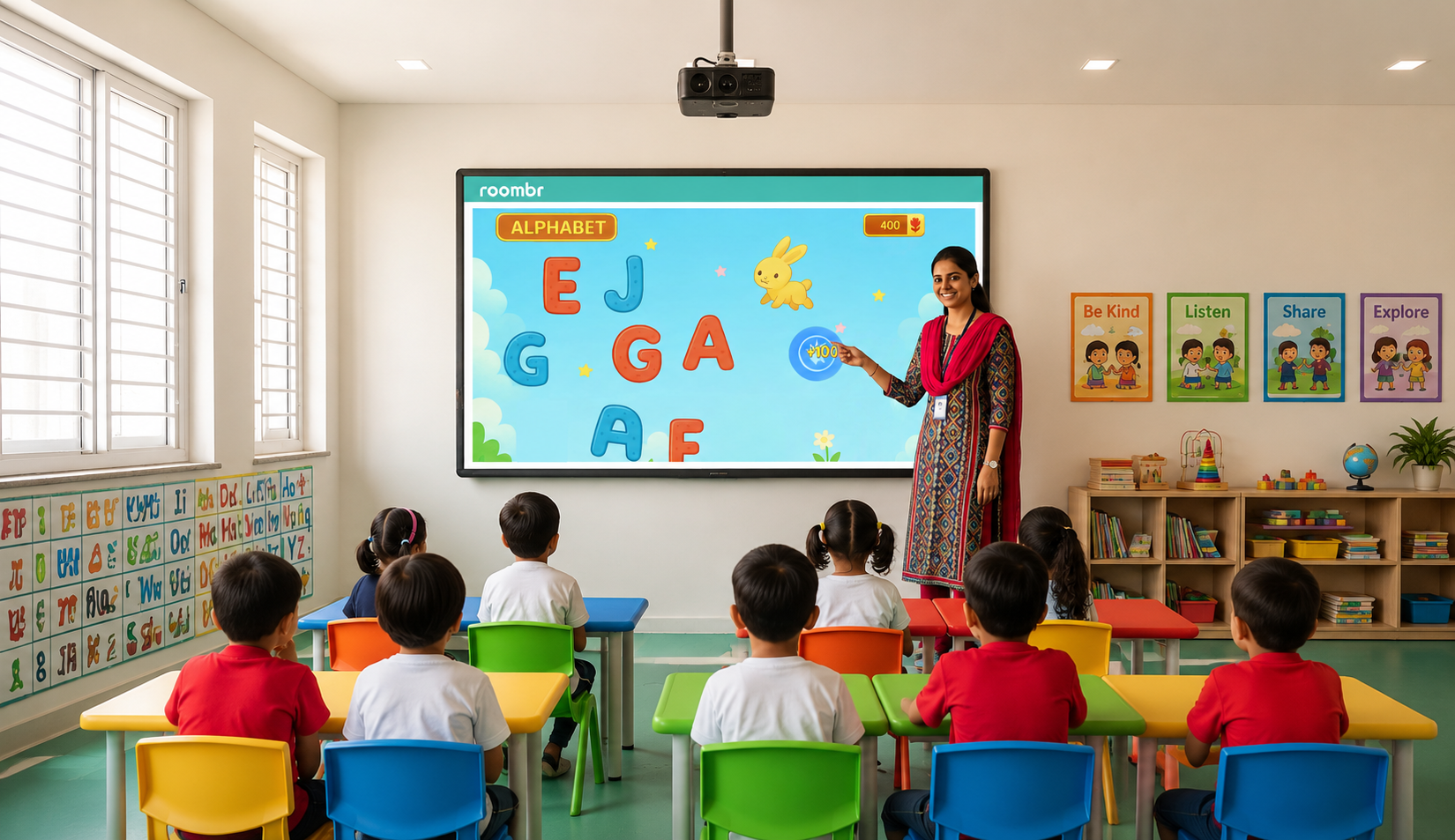
But for group games, songs, and counting activities, a large shared display helps every child see and join in at once. This is where Roombr Play, a projection-based interactive wall built specifically for preschoolers, can make a real difference.
Instead of a small screen a few children can crowd around, Roombr turns a wall into a big, touch-enabled surface. Teachers can display a counting game, play a rhyme with on-screen lyrics, or run a shared drawing activity that the whole group can reach.
It also comes with a built-in microphone and speakers, which makes song-based sessions easier to lead without extra equipment. For more on how large-format displays support early years learning, see our guide on 3D learning for preschool classrooms.
Final Thoughts
Great preschool activities do not need to be complicated or expensive. A crayon, a rhyme, or a simple counting game can do more for a young learner than any worksheet ever could.
Keep a rotation of drawing, rhyme, counting, storytelling, coloring, and group activities on hand. Mix them through the week and let repetition do the heavy lifting.
The goal is never to fill time. It is to give children small, repeated chances to build the skills they will lean on for years. A well-planned week of preschool activities does exactly that, one short session at a time.
Frequently Asked Questions
1. What are some easy activities for a nursery class?
Easy nursery activities include free drawing, action rhymes, counting claps, and simple picture-based storytelling. All of these need minimal setup and hold attention for 10 to 15 minutes.
2. How many preschool activities should a teacher plan per day?
Most preschool classrooms run well with three to four short activities daily. This usually includes one physical game, one creative task, and one language or number activity.
3. What preschool activities help with fine motor skills?
Drawing, coloring, tracing, and hands-on counting games all build fine motor control. These preschool activities strengthen the same hand muscles children later use for writing.
4. Are rhymes and songs considered educational preschool activities?
Yes. Rhymes and songs build phonemic awareness and vocabulary, both of which support early reading skills later on.
5. How long should a preschool activity last?
Most preschool activities should run between 5 and 15 minutes. Attention spans at this age are short, so shorter, varied activities work better than one long session.
6. Can preschool activities be used for mixed-age classrooms?
Yes. Most activities in this guide can flex up or down. Shorten instructions and duration for younger children, and add an extra step or challenge for older ones in the same group.
If you are ready to bring more of these preschool activities to life on a shared, interactive surface, explore Roombr for Kindergarten and see how it fits into your classroom.

Foziya Abuwala
Share
Step Into the future of
Education with Roombr