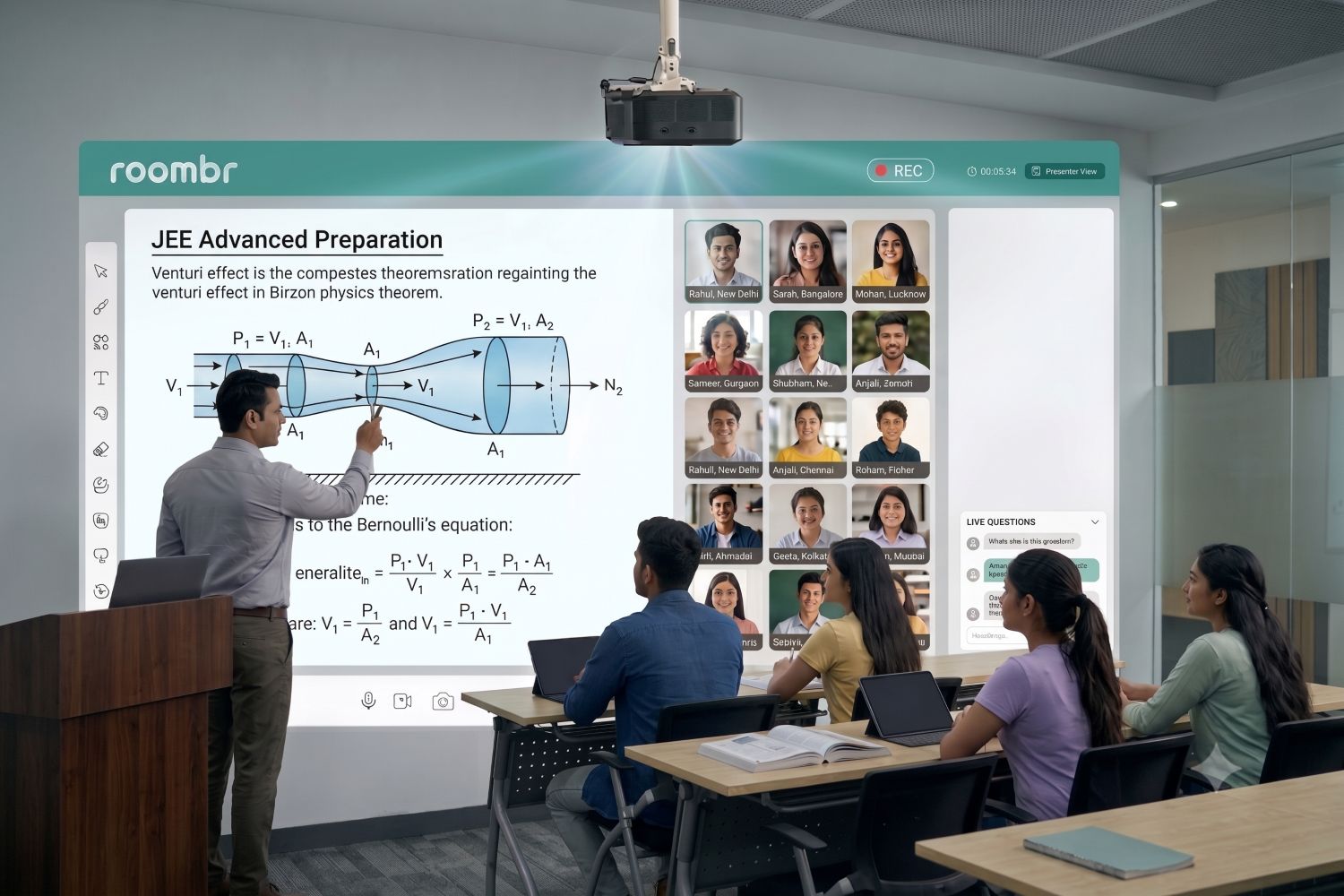


Schools across India are no longer asking whether AI will enter teaching. The real question is more practical: what type of AI content generator will help teachers save time, improve consistency, and support better classroom delivery without creating new problems?
That question matters because most schools do not need another good-looking tool. They need a system that helps teachers create lesson material faster, supports real teaching flow, fits curriculum needs, and works inside a broader digital classroom environment. At the same time, school leaders are becoming more careful about privacy, teacher oversight, and how AI-generated content is used in day-to-day education.
UNESCO’s current guidance also stresses a human-centred approach, including data privacy, ethical validation, and meaningful use in education. India’s school ecosystem is moving in the same direction, with new AI curriculum activity and teacher upskilling initiatives becoming more visible.
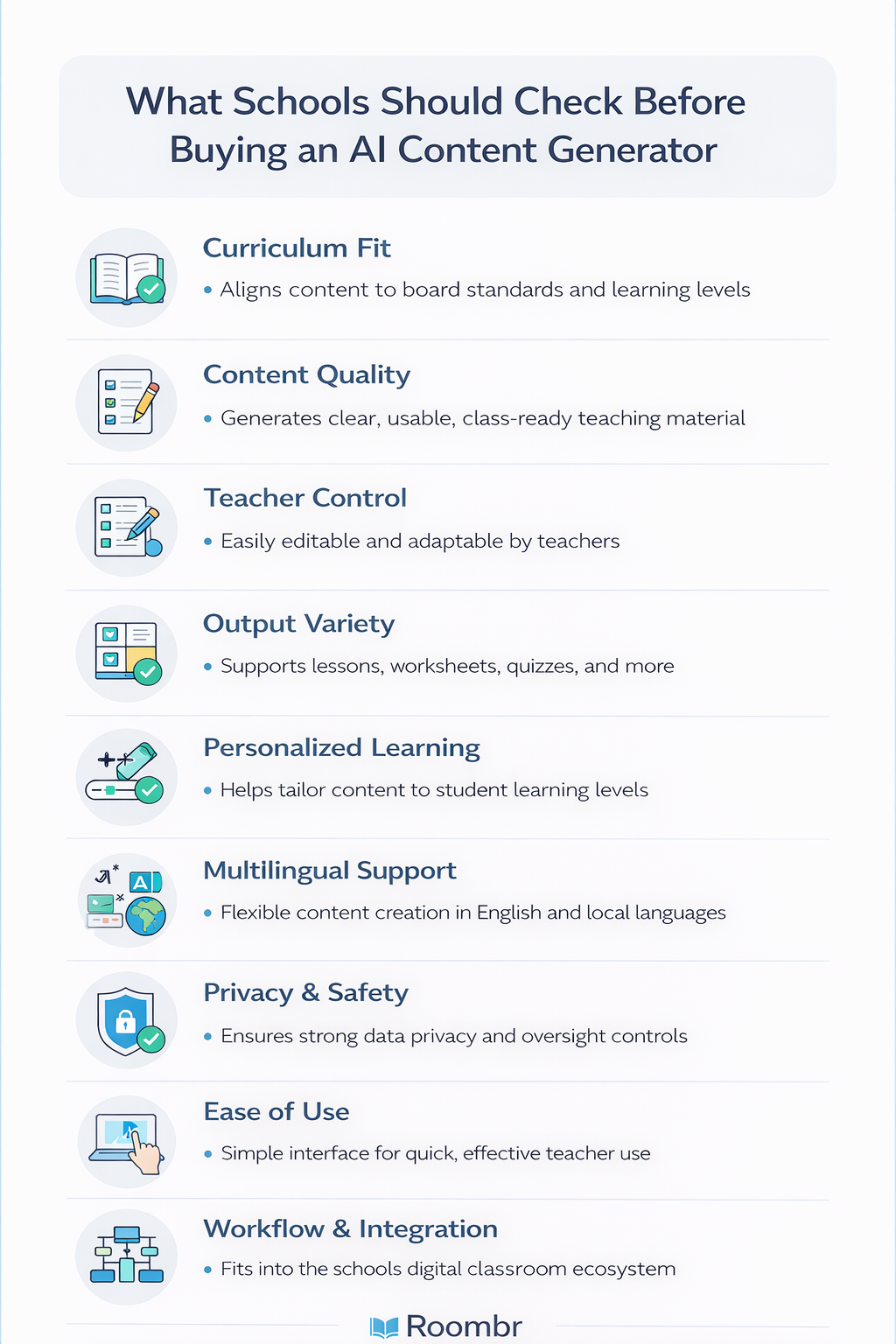
So, what should schools check before buying an AI content generator? In simple terms, they should evaluate curriculum fit, content quality, teacher control, usability, privacy, multilingual support, integration, training, and long-term value. That is what separates a useful school-ready solution from a tool that only looks impressive in a demo.
We have compiled this comprehensive guide to help schools make an informed decision when looking for the right AI content-generating solution that caters to their requirements.
Why More Schools in India Are Considering AI Content Generators
The daily workload of teachers has changed. A teacher is no longer just planning tomorrow’s lesson. They are also expected to prepare worksheets, recap notes, assessment questions, revision resources, activity prompts, and follow-up material for different learning levels. In many institutions, the demand for content increases further when classes are recorded, shared later, or reused across sections.
This is why an AI content generator is becoming relevant. Done well, it reduces drafting time and helps teachers move faster from “blank page” to “class-ready content.” Done poorly, it creates generic text that still needs major rework.
For school leaders, the value goes beyond speed. The right AI content generator can improve consistency across sections, support substitute teachers, make revision material easier to produce, and strengthen personalized learning by helping teachers adapt content for different learning levels. In other words, the best tools are not replacing teachers. They are reducing repetitive prep work so teachers can focus more on instruction, explanation, and student support.
What an AI Content Generator Should Mean in a School Setting
An AI content generator for education should not be treated like a general-purpose writing app. In schools, it needs to help with structured academic tasks such as:
- Lesson outlines
- Teaching explanations
- Class summaries
- Worksheets
- Question banks
- Quizzes and assessment tools support
- Homework and revision material
- Differentiated content for mixed learning levels
That distinction is important. A general AI tool may produce fluent text, but fluency alone is not enough for classroom use. Teachers need outputs that are relevant, editable, age-appropriate, and aligned to teaching intent.
A school-ready AI content generator should also support teacher judgment, not bypass it. The teacher must remain the final reviewer. That is especially important in Indian classrooms, where board expectations, language preferences, and classroom realities vary widely.
What Schools Should Check Before Buying an AI Content Generator
1. Curriculum and Board Alignment
The first question is simple: can the AI content generator create content that matches the academic structure your teachers follow?
A school may teach CBSE, ICSE, a state board, or a university syllabus. If the tool cannot adapt by class, subject, topic, and learning level, teachers will spend too much time fixing outputs manually. That defeats the purpose.
A useful buying question is:
Can a Grade 8 science teacher and a Grade 11 economics teacher both use the tool meaningfully on the same day without starting from scratch?
If the answer is unclear, the product is not ready for institutional scale.
2. Content Quality and Classroom Relevance
Many tools can generate text. Fewer generate teaching content that is usable.
A strong AI content generator should produce content that is:
- Factually sound
- Clear enough for the target class level
- Structured for teaching, not just reading
- Easy to adapt into activities, discussion, or revision
- Free from vague, filler-style explanations
For example, if a teacher asks for a worksheet on fractions, the output should not be a page of generic definitions. It should include age-appropriate problems, clear instructions, and a sensible progression in difficulty.
3. Teacher Control and Editability
One of the biggest buying mistakes is choosing an AI content generator that creates rigid content that teachers cannot easily refine.
Teachers need to shorten, expand, simplify, localize, and personalize content quickly. If editing is slow or awkward, adoption drops. In real schools, teachers do not have extra time to fight the interface.
This is where tools for teaching matter more than AI claims. The AI should help the teacher move faster, but the teacher should still feel fully in control of the final classroom output.
4. Output Variety
Schools should avoid paying for a tool that only handles one narrow use case.
A practical AI content generator should support multiple academic formats, such as:
- Lesson summaries
- Classroom explanations
- Quizzes
- Worksheets
- Homework
- Test questions
- Recap notes
- Differentiated learning material
This matters because teachers do not work in isolated content categories. A lesson often leads directly to revision, practice, and assessment. The more naturally the tool supports this flow, the stronger its value.
5. Support for Personalized Learning
One major advantage of an AI content generator is its ability to help teachers prepare content at different difficulty levels.
In a real classroom, one section may contain fast learners, average learners, and students who need reinforcement. An AI tool that can help teachers create easy, standard, and advanced versions of the same topic practically supports personalized learning.
That does not mean every child needs fully individualized content every day. It means teachers can more easily create differentiated explanations, practice sets, or revision sheets where needed.
6. Multilingual Practicality
India’s classrooms are rarely one-language environments in the strictest sense. Even when teaching is officially in English, explanation often shifts between English and local language support depending on the school, grade, and student comfort.
So the question is not just whether an AI content generator supports multiple languages. The real question is whether teachers can use it flexibly in multilingual teaching contexts.
Schools should check whether the tool allows teachers to:
- Simplify language quickly
- Adapt content for bilingual explanation
- Produce clearer versions for students with different language comfort levels
7. Privacy, Safety, and Governance
This is where many evaluations remain too shallow.
A school should never buy an AI content generator only because the output looks fast or polished. It must also ask how the platform handles privacy, moderation, and oversight. UNESCO’s guidance is clear that educational institutions need protection of user data, ethical validation, and human oversight when using generative AI.
At a minimum, schools should ask:
- What data is stored?
- Who can access generated content?
- Are there admin controls?
- Can teachers review content before students see it?
- Are there safeguards against inaccurate or inappropriate output?
For school leaders, this is not a side issue. It is part of responsible procurement.
8. Ease of Use in Daily Teaching
A product may perform well in a demonstration and still fail in real use.
The most successful teacher tools are not the ones with the longest feature list. They are the ones teachers can use confidently between back-to-back classes, under time pressure, without needing technical assistance every day.
So test the product like a real school day:
- Can a teacher create usable content in minutes?
- Can they edit it without confusion?
- Can a non-technical teacher use it comfortably after training?
If not, the tool may remain underused after purchase.
9. Integration with the Broader Digital Classroom
This is where commercial evaluation becomes more interesting.
A standalone AI content generator may help create drafts. But what happens next? Does the teacher copy-paste content into separate slide tools, whiteboards, LMS platforms, or test systems? Or does the platform connect naturally with teaching, recording, sharing, and assessments?
That matters because fragmented workflows create hidden costs: more training, more tool switching, and less consistency. Roombr positions its platform around this integrated teaching flow, with features such as automatic class recording, AI chapterization, smart editing, lesson sharing, AI-generated assessments, and progress tracking inside a broader digital classroom system. Roombr also emphasizes teacher training and ongoing support, which are important adoption factors for institutions.
10. Value at Institution Scale
The cheapest option is not always the lowest-cost option.
Here is a simple way to think about value:
If a school has 40 teachers, and each teacher saves even 30 minutes a day using the right AI content generator, that is 20 teacher-hours saved per day.
Calculation:
40 teachers × 0.5 hour = 20 hours per day
20 hours × 22 working days = 440 hours per month
That does not mean every saved minute becomes perfect productivity. But it shows why school buyers should think beyond subscription cost. The real question is whether the tool reduces repetitive work meaningfully across departments and grades.
A Practical Buying Scenario
Imagine two schools evaluating an AI content generator.
School A chooses a low-cost tool that writes fast paragraphs. Teachers still need separate apps for whiteboarding, tests, lesson sharing, and revision content. Adoption starts high, then drops because the workflow feels fragmented.
School B chooses a platform where the AI tool supports lesson creation inside a larger teaching environment. Teachers can create, edit, teach, record, share, and assess with fewer handoffs. Adoption is slower in week one, but stronger over the term because the tool fits real school operations.
That is why institutions should evaluate not just content generation, but the entire teaching flow around it. This is where broader smart classroom solutions can outperform isolated AI tools.
Standalone AI Content Generator or Integrated Platform?
This decision depends on the school’s maturity level.
A standalone AI content generator may be enough when:
- One or two teachers are experimenting
- The school only wants drafting support
- Adoption is still at a pilot stage
An integrated platform is often better when:
- Multiple teachers will use it
- Consistency matters across grades
- Recordings, assessments, and sharing are already important
- Leadership wants visibility and standardisation
- The school is investing in long-term smart classroom solutions
For institutions, that second category is common. They do not just need content generation. They need dependable and holistic tools for teaching that reduce friction across the full teaching cycle.
Final Buying Checklist for Schools
Before selecting an AI content generator, ask:
- Does it match our curriculum and class-level needs?
- Is the content accurate and classroom-ready?
- Can teachers edit outputs quickly?
- Does it support worksheets, quizzes, and assessment tools use cases?
- Can it support personalized learning needs?
- Will it work inside our digital classroom workflow?
- Are privacy, review, and admin controls clear?
- Can teachers adopt it easily after training?
- Does it reduce tool switching?
- Will it deliver value at a school scale, not just in a demo?
Conclusion
The best AI content generator for teachers in India is not the one that writes the most words. It is the one that helps teachers create better academic material faster, supports responsible school use, and fits naturally into how teaching happens.
For school leaders, that means looking beyond AI novelty. Evaluate the product like a real classroom tool. Check whether it supports curriculum-aligned content, practical teacher tools, meaningful personalized learning, and a wider digital classroom workflow.
And if your institution is already thinking beyond isolated tools toward connected smart classroom solutions, it makes sense to evaluate platforms that bring lesson creation, assessments, recordings, sharing, and teacher adoption into one ecosystem. Roombr’s offering is built around that integrated model, including AI-assisted lesson workflows, AI-generated assessments, recording and chapterization, and institution-ready support.
Frequently Asked Questions (FAQs)
1. What is the best AI content generator for teachers in India?
The best AI content generator is the one that combines curriculum fit, teacher control, usability, privacy, and workflow integration. Speed alone is not enough.
2. Can an AI content generator help with assessments?
Yes. A strong AI content generator can support quizzes, tests, worksheets, and other assessment tools, provided teachers can review and refine the outputs.
3. Should schools buy a standalone tool or an integrated platform?
If the goal is limited experimentation, a standalone tool may work. If the goal is institution-wide adoption, an integrated platform such as Roombr Digital Classroom delivers stronger long-term value.
4. Why does integration matter so much?
Because disconnected tools increase teacher effort. When content creation, delivery, revision, and assessment sit in different systems, friction rises, and adoption falls.
Build a Smarter Classroom with Roombr
Roombr brings schools more than just another teaching tool. It offers a complete, future-ready digital classroom solution that combines advanced hardware, powerful software, and intelligent automation in one seamless ecosystem. From classroom delivery and recording to assessments, lesson sharing, and analytics, every part is designed to work together. Its AI content generator is not a standalone add-on, but an integrated part of this all-in-one system that helps teachers create better classroom-ready content faster. If your school is looking for a smarter, more connected, and more practical way to teach, Roombr can help you move forward with confidence. Fill out our quick online form to book a demo with us and see how Roombr can fit your institution’s teaching and learning needs.

Foziya Abuwala
Share
Step Into the future of
Education with Roombr