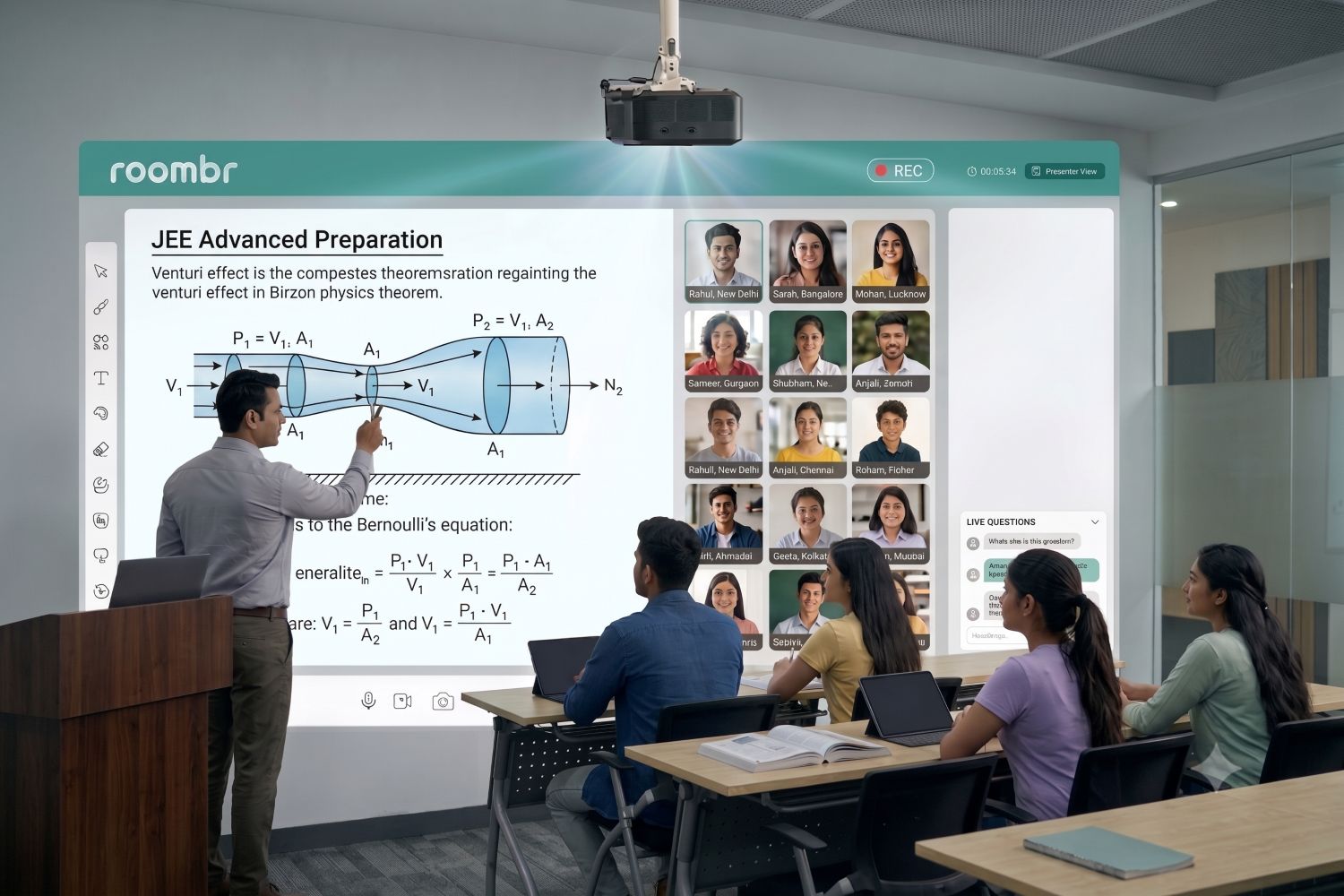


Schools, colleges, coaching centres, and training institutes in India are investing more seriously in digital systems. But during these discussions, one question often creates confusion:
Do we need an LMS, an ERP, or both?
The confusion is understandable. LMS and ERP are both used in education to improve how institutions function, offering better organization, visibility, and efficiency. However, each system solves a different institutional need.
An institution that wants to improve classroom learning may not get the right results by investing only in administration software. Similarly, a school struggling with fee records, attendance, and admissions may not solve those issues with a pure learning management system.
That is why understanding LMS vs ERP is important before making any decision.
What Is an LMS?
An LMS, or learning management system, is a digital platform or software designed to support teaching and learning.
For an educational institution, this usually means giving teachers and students one structured place for lessons, resources, assignments, tests, feedback, and progress tracking.
Instead of sending notes on WhatsApp, collecting assignments manually, or tracking tests through spreadsheets, teachers can use an LMS to organize academic activity more clearly.
A good LMS may help institutions manage:
- Lesson material and digital content
- Assignments and submissions
- Online tests and quizzes
- Student progress reports
- Recorded lesson access
- Teacher-student communication
- Revision resources
- Academic performance tracking
For example, if a Class 10 science teacher wants to share a chapter video, assign a worksheet, conduct a quiz, and see which students need extra support, an LMS can bring all those activities into one academic workflow.
The main users of an LMS are teachers, students, academic coordinators, and department heads.
What Is ERP in Education?
ERP stands for enterprise resource planning. In education, it is commonly known as education ERP, school ERP, or school management software.
An ERP is not mainly built for teaching. It is built for institutional operations.
It helps schools, colleges, and institutes manage the administrative side of daily functioning. This includes records, departments, fees, admissions, communication, and operational reporting.
A typical school ERP may support:
- Admissions management
- Student records
- Fee collection
- Attendance records
- Staff records
- Payroll
- Transport management
- Parent communication
- Administrative reports
For example, if a school wants to track which students have paid fees, generate attendance reports, update student records, and send notices to parents, school management software is useful.
The main users of ERP are administrators, accountants, office teams, principals, management teams, and operations staff.
LMS vs ERP: Key Differences at a Glance
The easiest way to understand LMS vs ERP is to compare what each system is responsible for.
The two systems should not be seen as competitors. They are more like two different parts of the same institutional ecosystem.
One supports academic delivery. The other supports administrative control.
When Does an Institution Need an LMS?
An institution should consider an LMS when the main challenge is related to teaching, learning, academic tracking, or student engagement.
This is common in institutions where teachers are using different tools for lessons, assignments, revision, and tests. Over time, this creates inconsistency.
One teacher may use Google Drive. Another may use WhatsApp. A third may rely only on printed notes. Students then struggle to find learning materials in one place.
Thus, an institution may need an LMS if:
- Teachers share learning materials through scattered channels
- Assignments are difficult to track
- Students do not have structured lesson access after class
- Assessments are manual or inconsistent
- Academic heads cannot identify learning gaps clearly
- Hybrid or blended learning is difficult to manage
- Teachers need better academic organization
- Students need revision support beyond classroom hours
Consider a college department with 600 students. If every faculty member follows a different method for sharing notes, collecting assignments, and conducting tests, academic monitoring becomes difficult.
A good LMS creates structure. It helps standardize learning delivery across classrooms, departments, and batches.
When Does an Institution Need ERP or School Management Software?
An institution should prioritize ERP when the bigger problem is administration.
This usually happens when teams are spending too much time on records, fee tracking, timetable coordination, attendance, or communication.
A school ERP is helpful when operational work is spread across registers, spreadsheets, phone calls, and disconnected software tools.
So, an institution may need ERP if:
- Fee records are difficult to manage
- Admissions data is scattered
- Attendance tracking takes too much time
- Student records are not centralized
- Parent communication is inconsistent
- Staff records are still manual
- Management does not get clean operational reports
Here is a simple example.
If one admin employee spends 3 hours a day updating fee records, attendance sheets, and student data, that becomes around 66 hours a month, assuming 22 working days.
If ERP reduces even half of that manual effort, the institution saves more than 30 hours every month from just one process area.
That is the practical value of school management software. It reduces administrative repetition and improves operational visibility.
Do Institutions Need Both LMS and ERP?
Many growing institutions eventually need both.
An ERP may store student records, but it does not manage how students learn. An LMS may track assignments and assessments, but it does not usually manage fees, admissions, transport, or payroll.
Here is a practical breakdown:
For smaller institutions, the immediate priority may be one system. For larger schools, colleges, coaching chains, or multi-campus institutions, both become necessary.
That is why many decision-makers now look for LMS solutions that can fit into their existing administrative setup instead of creating another disconnected platform.
Why LMS and ERP Integration Matters
Buying software is easy. Making it work smoothly inside an institution is the harder part.
When an LMS and ERP do not communicate, teams may end up doing the same work twice.
Common problems include:
- Duplicate student data entry
- Separate logins for different teams
- Outdated student lists
- Mismatched attendance records
- Manual report preparation
- Confusion between the academic and admin teams
- Low teacher adoption
- Extra dependency on IT support
For example, if student data is updated in ERP but not reflected in the LMS, teachers may continue using old class lists. If assessment data remains only in the LMS, management may not get a complete view of student performance.
Integration helps reduce this gap.
It allows academic and administrative information to move more smoothly, so leaders can make better decisions with less manual effort.
This does not mean every institution must buy both systems from one vendor. But it does mean institutions should ask the right questions before choosing software.
LMS vs ERP: Which One Should You Choose First?
There is no single answer for every institution. The right choice depends on the problem you need to solve first.
Choose an LMS first if your priority is improving classroom learning, academic delivery, assessments, and student progress tracking.
Choose ERP first if your priority is admissions, fees, attendance, communication, records, and operations.
Choose an integrated approach if your institution wants learning and administration to work together without creating duplicate work.
Common Mistakes Institutions Make While Comparing LMS with ERP
The most common mistake is assuming both systems do the same job.
They do not.
Another mistake is choosing software based only on the longest feature list. A system can have dozens of features and still fail if teachers, students, or administrators do not use it comfortably.
Institutions should avoid:
- Buying ERP when the real issue is academic delivery
- Buying an LMS when the real issue is admin inefficiency
- Ignoring teacher adoption
- Not involving administrative teams
- Choosing software without onboarding support
- Ignoring integration needs
- Not checking reporting capabilities
- Focusing only on price instead of long-term usability
A useful exercise is to list the top five daily problems your institution wants to solve.
If most problems are about lessons, assignments, assessments, and learning progress, you need an LMS. If most problems are about records, fees, attendance, and operations, ERP should come first.
Questions to Ask Before Choosing LMS or ERP
Before finalizing any platform, institutions should move beyond sales presentations and ask practical questions.
Questions to Ask Before Choosing an LMS
- Can teachers create and share lessons easily?
- Does it support assignments, quizzes, and assessments?
- Can students access learning material after class?
- Does it help track student progress?
- Can academic heads review useful reports?
- Is it easy for teachers to adopt?
- Can it support future digital classroom needs?
Questions to Ask Before Choosing ERP
- Can it manage admissions, fees, and records?
- Will it reduce manual admin work?
- Can it generate clear reports for management?
- Can it improve communication with parents or students?
- Is data migration included?
- What support is available after implementation?
These questions help institutions evaluate systems based on real daily use, not just software promises.
Key Takeaway
The difference between LMS and ERP becomes clear when institutions focus on the problem, not the product.
If the goal is to improve learning delivery, choose an LMS. If the goal is to improve administration, choose ERP. If both academic and operational workflows are disconnected, an integrated digital ecosystem may be the better long-term path.
Build a More Connected Learning Environment with Roombr
Roombr helps Indian institutions create a more structured, classroom-ready digital learning environment.
If your institution is comparing LMS solutions, ERP platforms, or a connected digital classroom setup, Roombr can help you evaluate what your teachers, students, and academic leaders need before you invest.
Book a Roombr demo to explore how your institution can support better teaching, learning, assessments, and academic monitoring with a future-ready digital classroom solution.

Foziya Abuwala
Share
Step Into the future of
Education with Roombr